All federal payments that are eligible for offset, except federal tax refunds, are categorized as federal administrative offsets. Participation by states in the Administrative Offset Program is optional. All case types that are eligible for federal tax refund offset are eligible for administrative offset. A debt may be submitted for administrative offset when it is at least $25, and is at least 30 days past due, although states have flexibility to determine a higher threshold.
Eligible NCPs are automatically submitted for administrative offset unless the states that certifies their arrearage amount excludes them, using the appropriate exclusion indicator(s) (CSEAS). Federal payments that are currently eligible for administrative offset are defined below:
- Vendor/Miscellaneous Payments – Vendor and miscellaneous payments can be offset at 100%.[bold for emphasis] Examples include expense and travel reimbursements. For some NCPs, this could include payments that were received for services performed on a government contract or payments that were received from an agricultural subsidy.
- Federal Retirement Payments – Currently, FMS offsets retirement pay at a rate of 25%.[bold for emphasis] If there is an income withholding in place, the state should exclude the past-due case from retirement administrative offset.
- Federal Salary Payments– Federal salary payments, while eligible for administrative offset, are not currently being intercepted for past-due child support. States should continue to use income withholding when dealing with NCPs who receive federal salaries.
Administrative Offset payments may be identified on the CFRXX screen.
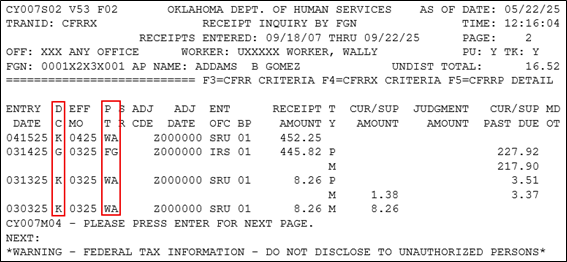
The payment Distribution Code will be G and the Payment Type will be FG for administrative offsets.
The payment Distribution Code will be I and the Payment Type will be FG if it is a federal tax offset.