Section 1: Military Compensation Structure
Military compensation is divided into three primary categories. Here is a breakdown of how each category works:
-
Base Pay
Think of Base Pay as the service member’s standard civilian salary or regular hourly wage. It is the predictable foundation of their paycheck.
- How it is calculated: The military does not negotiate salaries; instead, they use a grid based on two factors: the member’s rank (their pay grade, like an E-5 or O-3) and their years of service.
- Built-in raises: Service members receive automatic pay raises every two years as they gain experience, even if they do not earn a promotion to a higher rank.
- Taxes: Base pay is taxable income. The exception is if the service member is deployed to a designated combat zone, which makes their pay tax-exempt.
- Example: A Navy Petty Officer Second Class (an E-5 pay grade) who has served for six years earns a specific monthly base pay. Once they hit their eight-year mark, their base pay automatically increases.
-
Allowances
Think of Allowances as an employer giving you tax-free cash to pay your rent and grocery bills. Because military life forces people to move and live in expensive areas, the military pays these allowances to offset those living costs.
- How they work: The two most common allowances are the Basic Allowance for Housing (BAH) to cover rent, and the Basic Allowance for Subsistence (BAS) to cover food.
- Taxes and Child Support: Allowances are non-taxable, meaning the service member takes home the amount without the IRS taking a cut. Because this money reduces their personal living expenses and increases their disposable income, Oklahoma law under 43 O.S. § 118B requires it to be counted as income when calculating child support.
- The Clothing Exception: The military pays a once-per-year Clothing Maintenance Allowance, but this is typically excluded from child support calculations. This money is for replacing and repairing required military uniforms, not for supporting a household. (See “Behind the Uniform” NCSEA Web Talk 03-2026).
- Example: An Air Force Sergeant lives off base in an apartment. The military pays her a base salary, plus a monthly BAH of $1,400 to pay her landlord and a BAS of $460 to buy groceries. Even though the IRS does not tax the $1,860 in allowances, the family court counts it as income because it frees up her base pay for other uses.
-
Special and Incentive (S&I) Pays
Think of Special and Incentive Pays as overtime, hazard pay, or something like a bonus. The military uses this money to reward people with unique skills, to compensate for dangerous assignments, or to keep people from leaving the military for civilian jobs.
- How they work: A member receives this money on top of their base pay and allowances for performing specific duties. Examples include flight pay, sea pay, jump pay, and hazardous duty pay. It also includes military bonuses, such as a re-enlistment bonus to keep a trained mechanic in the service.
- Taxes and Child Support: Special and Incentive pay is taxable income, unless earned in a combat zone. Because this is money deposited into the member’s bank account that increases their overall earnings, it counts as income for child support.
- Example: An Army medic who jumps out of airplanes receives Parachute Duty Pay. A Navy sailor deployed on a submarine receives Career Sea Pay. If a cyber-security specialist agrees to stay in the military for another four years, they might receive a $30,000 Selective Reenlistment Bonus. All these payments are added to their gross income for child support calculations.
Section 2: The Leave and Earnings Statement (LES)
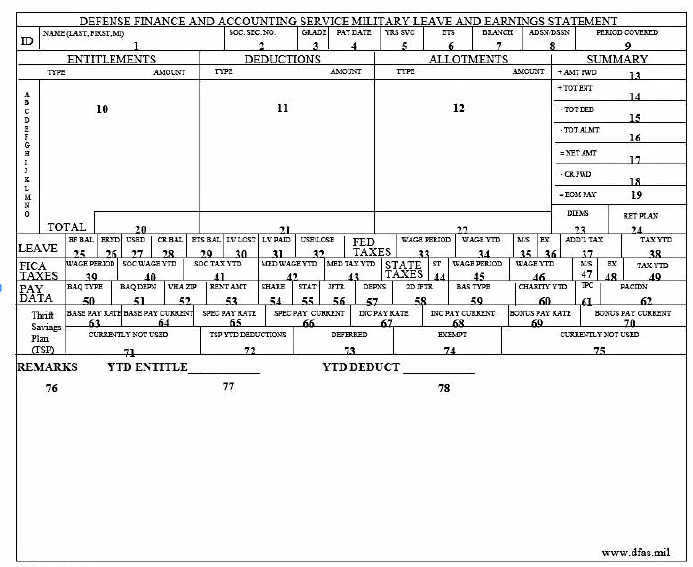
The LES is the comprehensive monthly pay record produced by the Defense Finance and Accounting Service (DFAS). The center of the LES contains four columns:
- Entitlements: Lists all income for the month, including base pay, allowances, and bonuses.
- Deductions: Lists mandatory withholdings like taxes, FICA, life insurance (SGLI), and the mid-month pay advance.
- Allotments: Lists voluntary payments authorized by the member, such as bank transfers or optional insurance. Do not mistake voluntary allotments for mandatory child support garnishments established under 42 U.S.C. § 659. Involuntary allotments can also be processed by DFAS pursuant to 42 U.S.C. § 665 and 32 C.F.R. Part 54.
- Summary: Totals the month’s figures to display net pay.
The Remarks section at the bottom of the LES displays Year-to-Date (YTD) entitlements, which is useful for identifying one-time bonuses or missing pay items.
Understanding Advanced Debt
Advanced Debt on an LES represents an overpayment or a cash advance given to the service member by the military. It commonly occurs to help cover immediate moving and relocation expenses during a Permanent Change of Station (PCS).
- How it works: When the military provides an advance, the amount is tracked on the statement. The military then establishes an automated repayment schedule, deducting a fixed amount from subsequent monthly paychecks until the balance is cleared.
- Child Support Impact: These clawbacks or debt deductions reduce the net take-home pay deposited into the member’s bank account. However, they do not lower their legally defined gross income. Child support guidelines must be calculated using the full gross income figures before any debt repayments are deducted.
- Example: A service member relocates to a new base under orders. The military advances $1,611.46 to help pay for temporary lodging and travel, creating an Advanced Debt record on the LES. In the following months, DFAS takes out deductions to recover that cash. It is suggested that child support caseworkers ignore these debt deductions and build the child support guidelines around the service member’s total gross earnings before the repayment occurs.
| 10 Entitlements | 11 Deductions | 12 Allotments |
| BASE PAY: $1,942.50
BAH: $1,666.56 BAS: $372.71 ADVANCE DEBT: $1,611.46 |
FEDERAL TAXES: $159.61
FICA-MEDICARE: $26.72 SGLI: $25.00 MEAL DEDUCTION: $453.15 TRADITIONAL TSP: $58.28 |
COMB FED CAMPAIGN: $5.00
TRICARE DENTAL: $30.15 |
Section 3: Verifying Income via the Child Support Portal
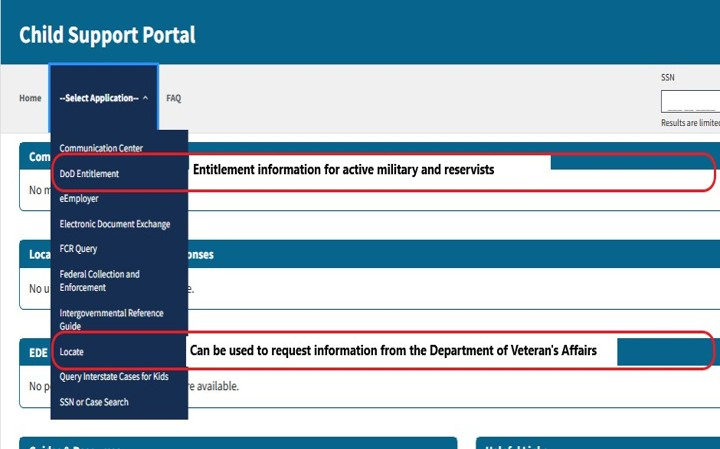
Child Support Portal – DoD Entitlement
When an LES is unavailable, staff can obtain a military address, rank, base pay, and entitlements using the DoD Entitlement request on the Child Support Portal. (Images below taken from navigation guide.)
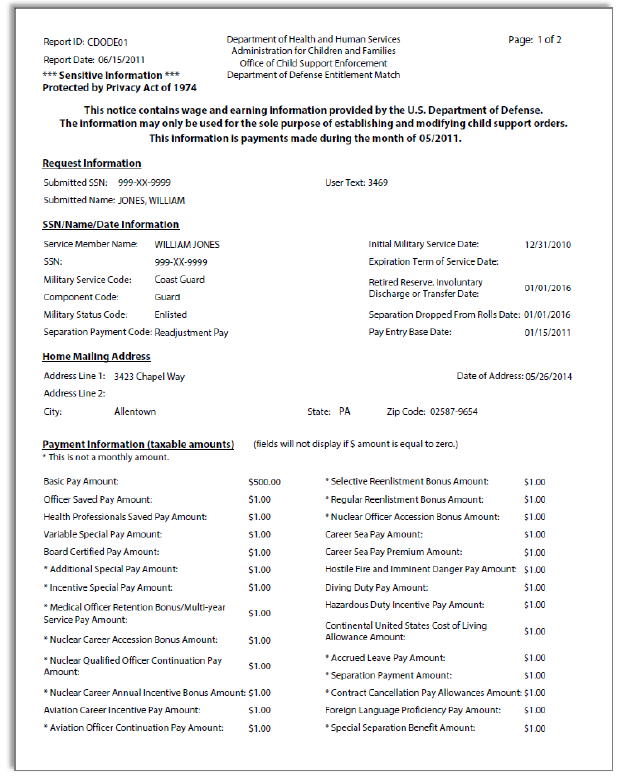
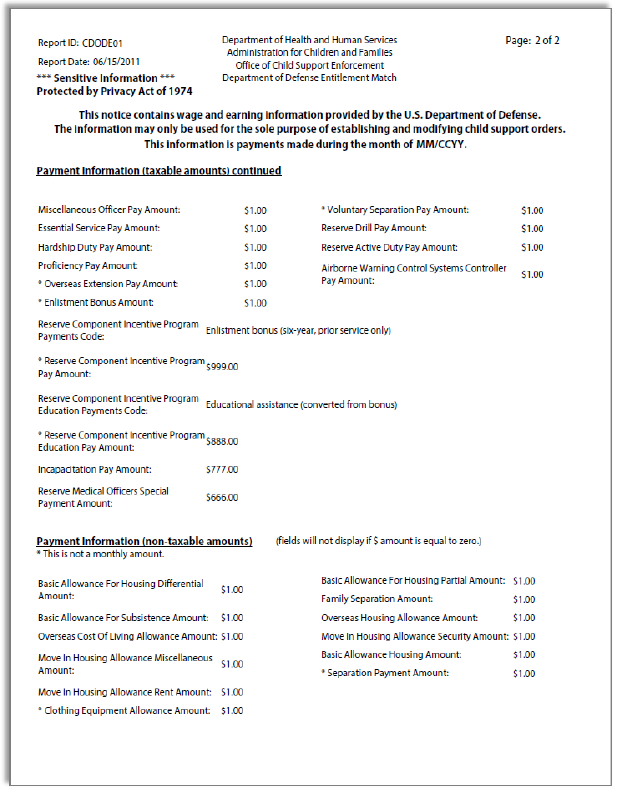
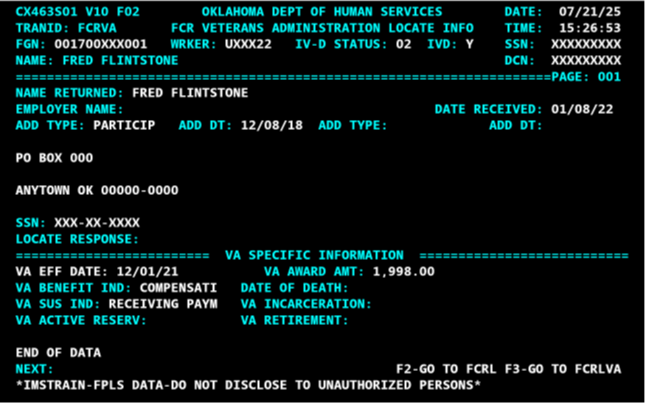
OSIS Screen FCRVA for VA Disability
Type VA into the FCRL index page to load the detailed FCRVA screen.
Section 4: VA Disability, Retirement, and Enforcement
Under the U.S. Supreme Court ruling in Rose v. Rose, 481 U.S. 619 (1987), VA disability payments are income for child support purposes. The payments are intended to support the veteran and their dependents.
Verification and Apportionment Rules
- VA payment amounts can be verified by calling 1-800-827-1000 and providing the veteran’s SSN and DOB.
- Under 38 U.S.C. § 5301(a), child support cannot garnish the VA directly unless the veteran waived military retirement to obtain the VA benefits (the waiver-offset exception under 42 U.S.C. § 659(h)(1)(A)(ii)(V)). However, as established in Case v. Dubaj, 2011 U.S. Dist. LEXIS 96808, bank accounts holding VA funds can be garnished.
New Apportionment Rules 2026-00237 (91 FR 899)
Effective February 9, 2026, the VA ceased processing and granting new need-based apportionments, deferring to state family courts to issue child support awards. The following parameters apply:
- Exceptions: The VA will process new apportionments using VA Form 21-0788 only in cases of felony incarceration for more than 60 days, or institutionalized incompetency where an incompetent veteran without a fiduciary receives care at government expense.
- Existing Apportionments: Apportionments established prior to February 9, 2026, remain active. The VA will not make monetary adjustments to existing apportionments.
Special Compensation Programs
- Concurrent Retirement and Disability Pay (CRDP): Restores retired pay for longevity retirees with a VA rating of 50% or higher. CRDP is taxable and fully garnishable.
- Combat-Related Special Compensation (CRSC): Provides tax-free payments for combat-related disabilities. CRSC is subject to garnishment for child support.
Military Retirement and TSP
Retirees fall under either the High-3 system or the Blended Retirement System (BRS). Under BRS, the Department of Defense matches contributions to the Thrift Savings Plan (TSP). TSP accounts can be garnished using the federal TSP-CS-1 form.
Section 5: Sources for Further Study
For more detailed information, specific guidelines, and federal forms, consult the following digital platforms and agency guidelines:
- Defense Finance and Accounting Service (DFAS) Garnishment Operations: Detailed guides on income withholding orders, military allowances, and involuntary allotments.
- NCSEA Behind the Uniform: A Child Support View of Military Compensation, Veteran Benefits & TRICARE
- Federal Office of Child Support Enforcement (OCSE): Access the complete resource document, Working with the Military on Child Support Matters
- Department of Veterans Affairs (VA): VA disability compensation
- Federal Register Public Inspection Gateway: View the absolute rule text for Department of Veterans Affairs Apportionment of Monetary Benefits (91 FR 899, Docket VA-2021-VBA-0025) via gov.
- S. Department of Labor (DOL) Employment Toolkit: Cross-reference military specialties with regional civilian pay and evaluate transferable skills using the O*Net Military Crosswalk at onetonline.org and real-time job vacancy monitoring at careeronestop.org.
- Office of Child Support Enforcement: Locate Application Navigation Guide (Version 3.0, March 15, 2019).Technical documentation detailing national directory tracking parameters, search profiles, and verification loops.
- Office of Child Support Enforcement: Department of Defense Entitlement Application Navigation Guide (Version 6.0, March 17, 2021). Guide for managing individual case selections, match requests, and electronic pay allocations on the portal.
- To obtain copies of the above two Navigation Guides, email a request to pfrs@okdhs.org, or csportal@acf.hhs.gov
- How to Read an Active Duty Army Leave and Earning Statement